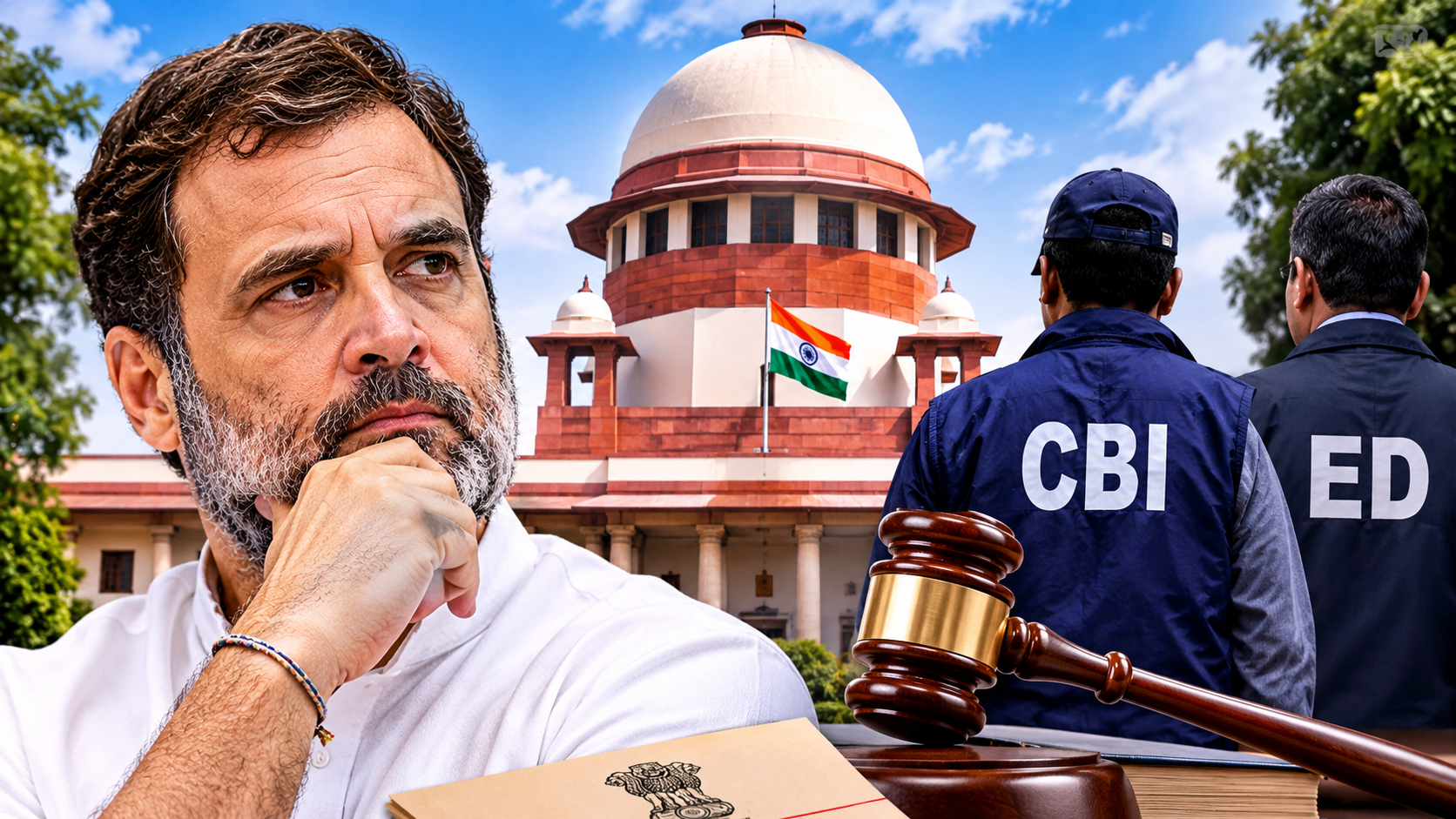
n the Rahul Gandhi assets case, the Supreme Court on Wednesday, November 25, set aside the Allahabad High Court's orders that had asked the Central Bureau of Investigation (CBI) and the Enforcement Directorate (ED) to look into allegations of disproportionate assets against him. The top court sent the matter back to the High Court and said Gandhi must be heard before any order is passed against him, as reported by Scroll.
Gandhi is the Leader of the Opposition in the Lok Sabha.
The bench gave these directions, according to the Free Press Journal:
The court also told the CBI and ED not to file any report in response to the High Court's earlier directions, Scroll reported.
The case started with a petition by S Vignesh Shishir, a BJP worker. He alleges that Rahul Gandhi holds assets that are more than his known sources of income, and he has asked for a probe into Gandhi and his family members.
Gandhi challenged the High Court's directions in the Supreme Court, saying they were passed without hearing him.
Here is a simple timeline of the case, based on reports by Scroll and the Free Press Journal:
Gandhi's main argument was that the High Court passed its orders without hearing him. In August, the Supreme Court had also noted that the High Court acted without giving him a chance to be heard.
He also argued that the petitioner had no legal right (locus standi) to bring the case and had not disclosed his credentials. He questioned how details of confidential proceedings appeared in newspapers, according to Scroll.
No. The Supreme Court has not cleared Gandhi of the allegations, and it has not ruled on whether they are true. It has only said that the High Court's orders were passed without hearing him, and that the case must be heard again properly.
The High Court will now decide afresh whether the petition can go ahead and, if it does, what should happen next. Both sides will be able to present their arguments.
A disproportionate assets (DA) case is one where a person is accused of owning money or property worth more than what their known, legal income could explain. Such cases are usually investigated by agencies like the CBI, and the ED may get involved if money laundering is alleged.
An allegation alone does not mean guilt. The person has the right to explain the source of their assets, and only a court can decide the matter.
At the time of writing, reports did not carry any official reaction from the Congress, the BJP, the CBI or the ED on Wednesday's order. We will update this story when statements come in.
Earlier this month, Rahul Gandhi had made a separate allegation that his phone was being tapped, which the BJP called baseless. Read our report on that phone-tapping row. For another recent Supreme Court decision, read about its ruling on firecrackers this Diwali.
FAQ
Q1. What did the Supreme Court decide in the Rahul Gandhi assets case? It set aside the Allahabad High Court's orders asking the CBI and ED to examine allegations of disproportionate assets against him, and sent the matter back for a fresh hearing.
Q2. Which judges heard the case? Chief Justice of India Surya Kant, Justice Joymalya Bagchi and Justice V Mohana.
Q3. Who filed the petition against Rahul Gandhi? S Vignesh Shishir, a BJP worker.
Q4. Has Rahul Gandhi been cleared? No. The Supreme Court did not rule on the allegations. It asked the High Court to hear the matter again after making Gandhi a party.
Q5. Will the hearing be held in secret? No. The Supreme Court said the hearing must be held in open court.