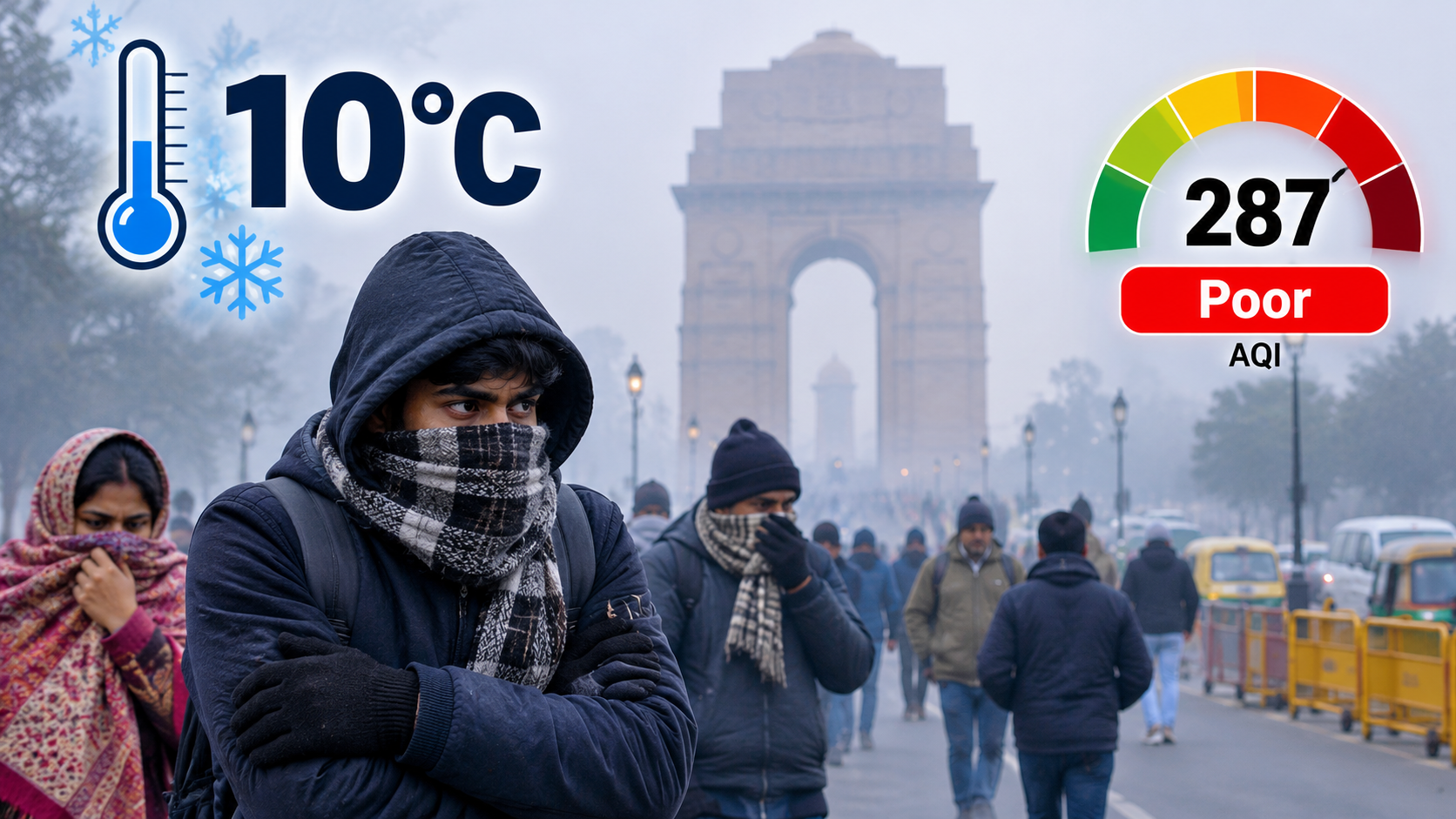
Delhi weather today brought the coldest morning of the season so far. On Wednesday, November 25, the minimum temperature at Safdarjung, Delhi's main weather station, dropped to 10 degrees Celsius. That is 1.3 degrees below normal for this time of year and 1.2 degrees lower than on Tuesday, as reported by Daily Excelsior and BozokMedia.
The air also stayed bad. The city's average Air Quality Index (AQI) was 224, which is in the "poor" category.
Other weather stations also recorded cold mornings, according to Global Governance News:
The India Meteorological Department (IMD) expects the day's highest temperature to be around 25°C, with shallow fog over the city, as per AIR News.
The city's average AQI stood at 224, according to Central Pollution Control Board (CPCB) data reported by AIR News. Four monitoring stations recorded "very poor" air, with readings above 300.
AIR News said the city's average has stayed stuck at this level, as colder surface temperatures trap vehicle and factory pollution near the ground. The Patriot also reported the same AQI figure of 224.
When the ground cools at night, the air near the surface becomes cold and heavy. A layer of warmer air sits above it like a lid. This is called a temperature inversion. Smoke and dust from vehicles, factories and fires get trapped close to the ground, where we breathe.
Calm winds make it worse, because there is nothing to blow the pollution away. That is why Delhi's air is often at its worst on cold, still winter mornings.
At 224, the air is "poor". People with asthma, heart problems, older adults and young children are most at risk if they stay outside for long.
Earlier this month, the AQI touched 246 on November 17. Read our report on Delhi AQI and GRAP Stage 3.
Delhi has its own winter pollution curbs. Vehicles registered outside Delhi that are BS-IV or older are not allowed into the city till January 31. Read our explainer on the Delhi winter pollution plan for the full list of rules. Check the Commission for Air Quality Management (CAQM) website for the latest GRAP stage.
For the cold:
For the pollution:
Shallow fog can reduce visibility in the early morning, especially on highways and near the Yamuna.
Morning fog in north India can delay trains and early flights during winter. If you are travelling in the coming days, check your train's running status on the Indian Railways NTES app or website, and check your flight status with your airline before leaving home.
Night temperatures usually keep dropping through late November and December in Delhi. With colder nights, fog may become more frequent, and pollution may stay high unless strong winds or rain come in. Keep checking IMD and CPCB updates before stepping out.
FAQ
Q1. What was Delhi's minimum temperature today? 10°C at Safdarjung on November 25, 2026, the coldest morning of the season so far.
Q2. What is Delhi's AQI today? The average AQI was 224, which is in the "poor" category.
Q3. Will there be fog in Delhi today? IMD forecast shallow fog over the city.
Q4. What is the maximum temperature expected today? Around 25°C.
Q5. Why does pollution get worse in winter? Cold air near the ground traps smoke and dust under a layer of warmer air, and calm winds stop it from spreading out.