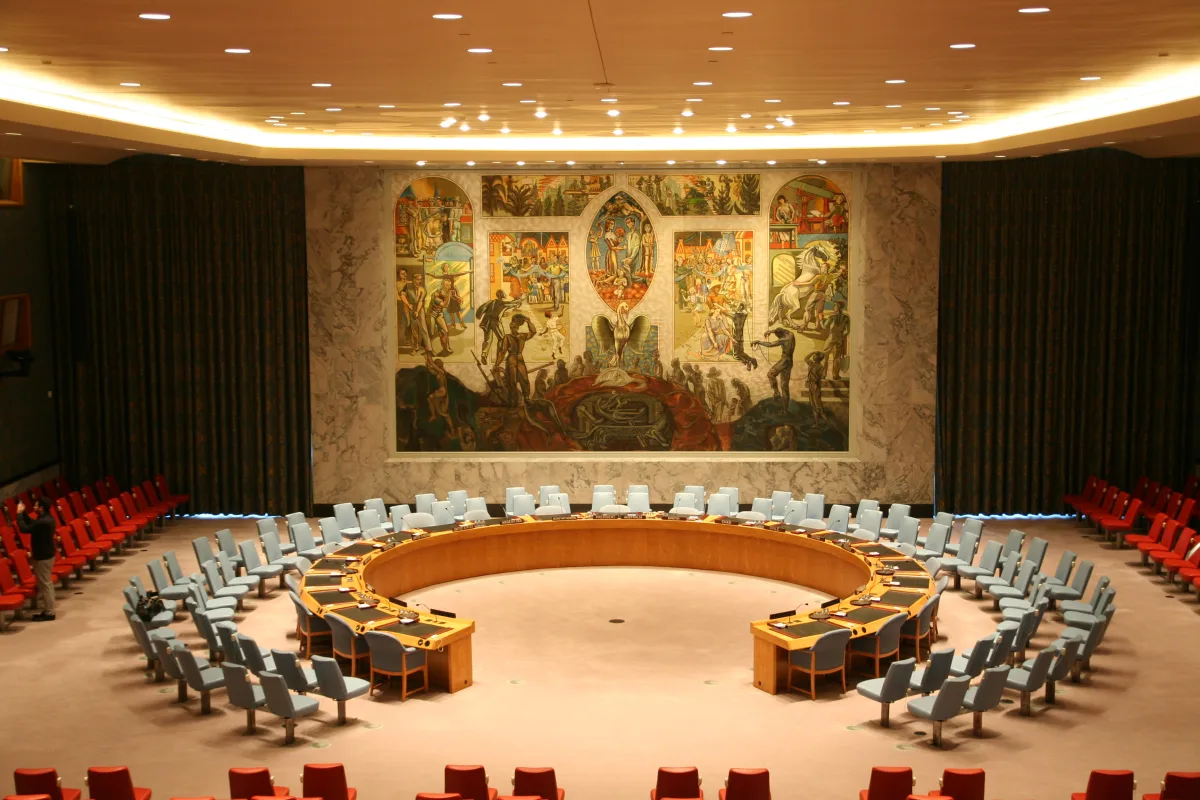
UNITED NATIONS: Secretary-General António Guterres has repeated that the UN Security Council must grow to reflect the organisation's wider membership, after External Affairs Minister S. Jaishankar said the body had to be reformed to stay relevant.
Guterres "has consistently maintained that, as the United Nations has expanded, the Security Council must also expand and become more representative of the wider membership", his deputy spokesperson Farhan Haq said, responding to Jaishankar's remarks, All India Radio reported on October 6. Guterres warned member states of the consequences of failing to reform the Council and urged them to move the stalled process forward, the broadcaster said.
Jaishankar had said the UN's highest decision-making body must be reformed to remain relevant, since UN membership has nearly quadrupled since the organisation was founded in 1945.
The Security Council has 15 members: five permanent members, Russia, China, the United States, the United Kingdom and France, and ten non-permanent members elected by the General Assembly for two-year terms. The five permanent members each hold a veto over substantive resolutions, so any one of them can block a draft.
India, Brazil, Germany and Japan, which campaign together as the G4, want new permanent seats as well as more non-permanent ones.
Jaishankar chaired a meeting of G4 foreign ministers in New York on September 22, on the sidelines of the 81st UN General Assembly, The Tribune reported. "Discussed the imperative of reformed multilateralism and a more representative, responsive and effective UN Security Council that reflects today's global realities," he said afterwards. The four countries pledged to keep working together to advance reform of the multilateral system, The Tribune reported.
The ministers noted that the intergovernmental negotiations on reform have now run for 18 years without a concrete outcome, Open reported. In their joint statement they said the Council "is currently unable to effectively discharge its core responsibility of maintaining international peace and security".
The G4 want expansion in both the permanent and non-permanent categories, with greater representation for Africa, the Asia-Pacific and Latin America and the Caribbean, and a greater say for countries that contribute significantly to international peace and security. They also back African representation in the permanent category.
Their immediate demand is for text-based negotiations, the stage at which member states negotiate on a written draft rather than exchange positions. The ministers objected to a "bridging proposal" being put forward before such negotiations had begun, and said they would work on a consolidated model reflecting the views of a majority of member states, according to Open. Progress is to be reviewed at a meeting of senior G4 officials in New Delhi.
Speaking at the fifth Kautilya Economic Conclave in New Delhi on October 5, Jaishankar said "the Global South expects India to articulate the region's concerns in front of the global stage", including on what he called the four Fs: food, fuel, fertiliser and finance, All India Radio reported.
India's approach of multi-alignment, he said, "enables it to engage with all important players in the world, including US, Russia and China", in a world moving towards multipolarity whose "architecture and geometry are very different from the way it used to be".
For now, the debate turns on whether member states can agree even on the text they will negotiate, and on whether the meeting of G4 officials in New Delhi can report any movement.