

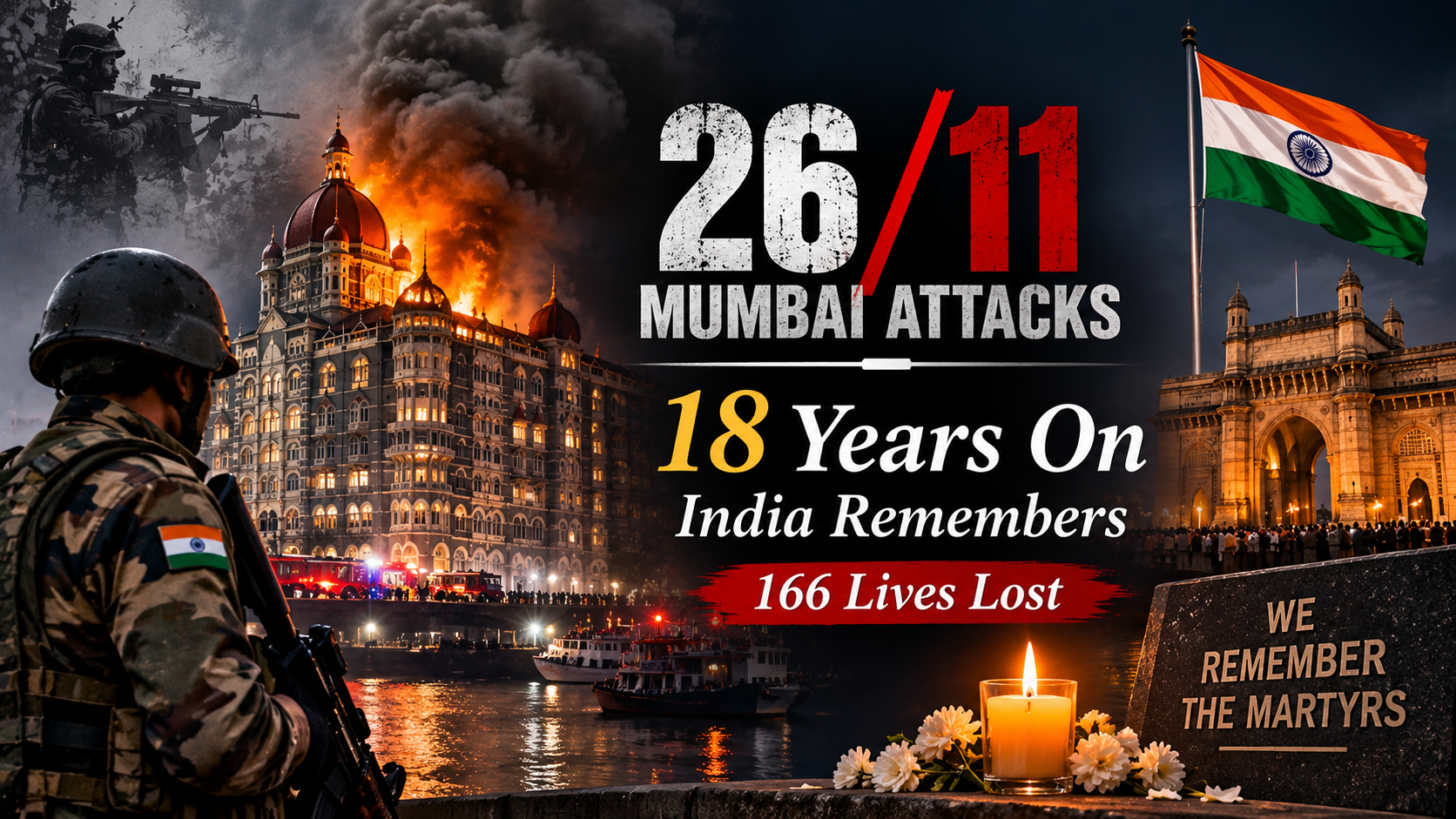
The 26/11 Mumbai attacks took place exactly 18 years ago today. On the night of November 26, 2008, ten heavily armed Lashkar-e-Taiba terrorists who came in by sea launched a 60-hour assault on India's financial capital. They killed 166 people and wounded more than 300, as recalled by AIR News.
Today, Mumbai and the country remember the victims and honour the police officers, commandos and ordinary people who gave their lives to save others.
26/11 Mumbai attacks: key facts↑
- Dates: November 26 to 29, 2008
- Duration: About 60 hours
- Attackers: 10 Lashkar-e-Taiba (LeT) terrorists who came from Pakistan by sea
- Killed: 166 people, including 26 foreign nationals from 14 countries
- Injured: More than 300
- Attackers killed: 9; one, Ajmal Kasab, was caught alive
- Kasab's execution: November 21, 2012, at Yerwada Central Jail, Pune
How the attacks unfolded↑
The attackers landed on Mumbai's shore in inflatable boats on the evening of November 26, 2008. They split into small groups and hit several crowded places at the same time, according to Wikipedia's record of the attacks:
- Chhatrapati Shivaji Terminus (CST) railway station
- The Taj Mahal Palace Hotel
- The Oberoi Trident hotel at Nariman Point
- Leopold Cafe
- Nariman House (Chabad House)
- Cama and Albless Hospital
The longest sieges were at the Taj, the Oberoi Trident and Nariman House. Mumbai Police, Marine Commandos and the National Security Guard (NSG) fought room by room for nearly three days before the last attackers were killed on the morning of November 29.
Heroes who gave their lives↑
Many security personnel died while protecting others. Among them were:
- Hemant Karkare, Joint Commissioner of Police and chief of the Mumbai Anti-Terrorism Squad
- Ashok Kamte, Additional Commissioner of Police
- Vijay Salaskar, Senior Inspector
- Tukaram Omble, Assistant Sub-Inspector, who was killed while grabbing Kasab's gun, which helped police capture him alive
- Major Sandeep Unnikrishnan of the NSG, who was killed at the Taj while rescuing a fellow commando
- Havildar Gajender Singh Bisht of the NSG, who was killed at Nariman House
Hotel staff, railway employees, doctors and nurses also showed great courage that night, helping hundreds of people escape.
Kasab's capture and trial↑
Ajmal Kasab was the only attacker caught alive. He was arrested in the early hours of November 27, 2008. After a long trial in Mumbai, he was sentenced to death and hanged at Pune's Yerwada Central Jail on November 21, 2012.
The case also exposed a wider conspiracy. David Coleman Headley, who scouted targets in Mumbai before the attack, later gave evidence to an Indian court by video link from a US prison, AIR News reported.
Tahawwur Rana now faces trial in India↑
Tahawwur Hussain Rana, an alleged co-conspirator, was extradited from the United States in 2025. The National Investigation Agency (NIA) formally arrested him on April 10, 2025, after he arrived in India. He now faces trial in India, and prosecutors are preparing their case, according to AIR News.
The LeT handlers who are accused of guiding the attackers by satellite phone during the siege are still in Pakistan, out of reach of Indian arrest warrants.
How India's security changed after 26/11↑
The attacks showed serious gaps in coastal security and in coordination between agencies. Several big changes followed:
- National Investigation Agency (NIA): A central agency to investigate terror cases was set up after the attacks.
- NSG hubs: NSG units were set up in major cities, including Mumbai, so commandos can reach an attack site faster.
- Coastal security: India strengthened its coastal radar network and sea patrolling to stop attackers coming in by boat.
An official told IANS that Lashkar-e-Taiba has been weakened over the years and now operates on a smaller scale, as reported by Bhaskar Live.
Mumbai remembers↑
Tributes began days before the anniversary. On November 22, cricketer Sachin Tendulkar and others joined a peace tribute at the Gateway of India, organised by the Divyaj Foundation to honour the martyrs, according to an IANS photo report on Social News XYZ.
Every year on November 26, leaders and senior police officers place wreaths at the Police Martyrs' Memorial at the Mumbai Police Commissionerate, and meet the families of those who died. Families of the victims are also gathering at memorial services across the city this year, AIR News reported.
Why 26/11 still matters↑
Eighteen years later, 26/11 remains one of the darkest days in India's history. It is a reminder of the cost of terrorism and of the courage of those who stood up to it. It also reminds us why strong security, quick response and alert citizens matter.
By coincidence, November 26 is also Constitution Day, when India remembers the adoption of its Constitution in 1949. Read our report on Constitution Day 2026. You can also read our earlier report on the blast near Delhi's Red Fort.
FAQ
Q1. When did the 26/11 Mumbai attacks happen? From November 26 to 29, 2008.
Q2. How many people were killed in the 26/11 attacks? 166 people were killed, and more than 300 were injured.
Q3. Which places were attacked? CST station, the Taj Mahal Palace Hotel, the Oberoi Trident, Leopold Cafe, Nariman House and Cama Hospital, among others.
Q4. What happened to Ajmal Kasab? He was caught alive, tried in Mumbai and hanged at Pune's Yerwada Central Jail on November 21, 2012.
Q5. Which anniversary of 26/11 is it in 2026? The 18th anniversary.

0 comments
No comments yet. Comments are read by our team before they appear.