
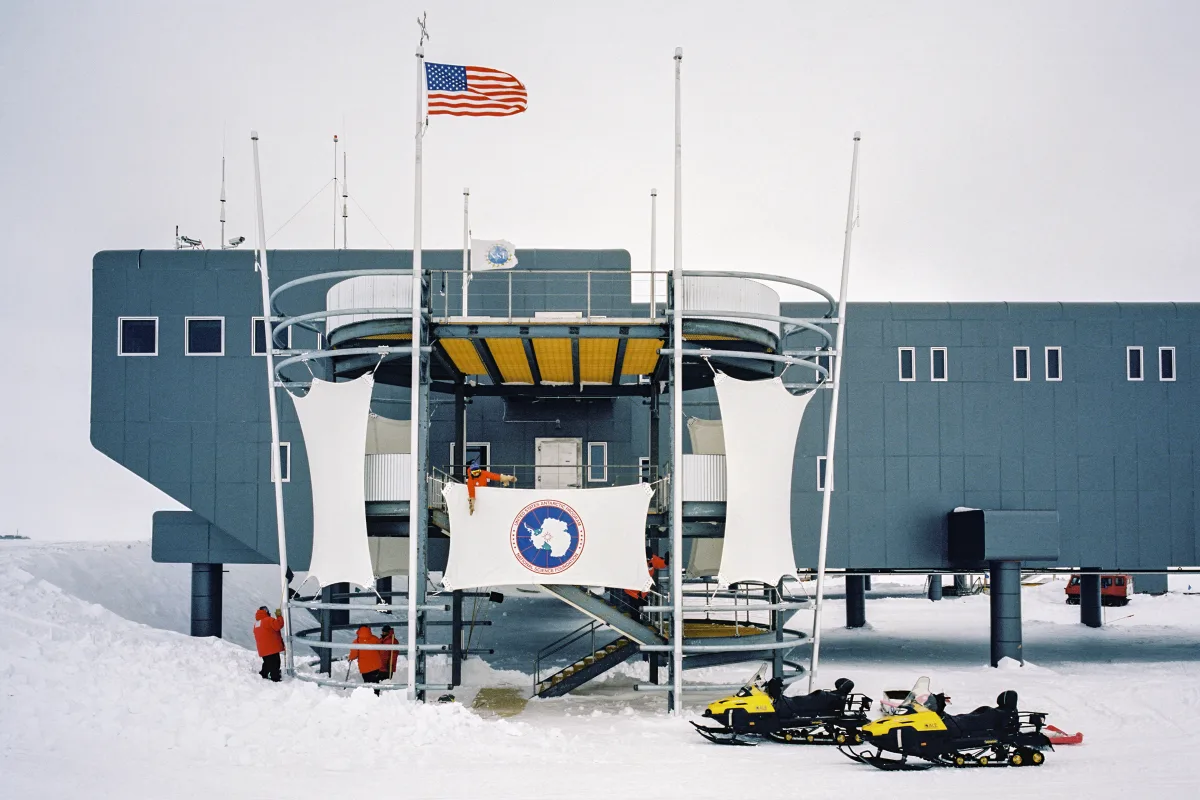
STOCKHOLM: The 2026 Nobel Prize in Physics has been awarded to Francis Halzen, the Belgian-born physicist who led the building of a neutrino detector inside the ice at the South Pole, "for decisive contributions to the IceCube Neutrino Observatory and the discovery of high-energy neutrinos of astrophysical origin".
The Royal Swedish Academy of Sciences announced the prize on October 6. Halzen, 82, is a professor at the University of Wisconsin-Madison and the principal investigator of IceCube. He receives the full prize of 12 million Swedish kronor, about $1.2 million.
"Francis Halzen has led an international team of researchers and engineers who have provided us with a fantastic instrument. His tenacity and scientific vision has paved the way for a new kind of astronomy," said Mark Pearce, chair of the Nobel Committee for Physics, France 24 reported.
The academy reached Halzen by telephone in Bergamo, Italy, where he was taking part in the BergamoScienza festival. "It was a huge surprise and, of course, I wasn't expecting it," he said, according to Il Sole 24 Ore.
Catching the ghost particle
Neutrinos are elusive particles that pass through matter without leaving traces, which makes them extremely hard to detect, Il Sole 24 Ore noted. Halzen's idea, in the late 1980s, was to use the clear, deep ice at the South Pole as a detector. That led first to a project called AMANDA, which became the IceCube Neutrino Observatory in 2005, Il Sole 24 Ore reported.
IceCube is built into the ice at the Amundsen-Scott South Pole Station. Its sensors are spread through a cubic kilometre of ice. The original 86 strings carry digital optical modules, light sensors with photomultiplier tubes, at depths between 1,450 and 2,450 metres, with 60 modules on each string. Construction began in 2005 and was completed in December 2010, at a total cost of $279 million. An upgrade completed in February 2026 added five more densely instrumented strings with more than 600 newer sensors.
A new kind of astronomy
In November 2013, IceCube announced 28 neutrinos that likely came from outside the solar system. In July 2018, it traced an extremely high-energy neutrino to a blazar, TXS 0506+056, about 3.7 billion light-years away. In November 2022, it detected neutrinos from the active galactic nucleus of the galaxy Messier 77, and in June 2023 it identified neutrino emission from the plane of our own Milky Way.
The discovery, Il Sole 24 Ore wrote, established a completely new branch of astronomy, the field the Nobel committee chair called "a new kind of astronomy".
The laureate
Halzen was born on March 23, 1944, in Tienen, Belgium. He studied at the University of Leuven, earning his first degree in 1966 and his PhD in 1969, and worked as a scientific associate at CERN in Geneva from 1969 to 1971. He joined the University of Wisconsin-Madison in 1972, where he became Hilldale and Gregory Breit Distinguished Professor, and has been principal investigator of AMANDA and then IceCube since 1987. His earlier honours include the Physics World Breakthrough of the Year in 2013, the Balzan Prize for astroparticle physics in 2015, the Bruno Pontecorvo Prize in 2018 and the Yodh Prize in 2019, as well as the American Physical Society's medal for exceptional achievement in research.
The physics prize, first awarded in 1901, has been given 119 times to 229 people, Scientific American reported. A neutrino discovery has been honoured before: Frederick Reines won in 1995 for detecting low-energy neutrinos. Recent prizes went to studies of electron motion in 2023, the foundations of artificial intelligence models in 2024, and quantum phenomena in large devices in 2025.
The prize will be presented in Stockholm on December 10, the anniversary of Alfred Nobel's death.
0 comments
No comments yet. Comments are read by our team before they appear.