

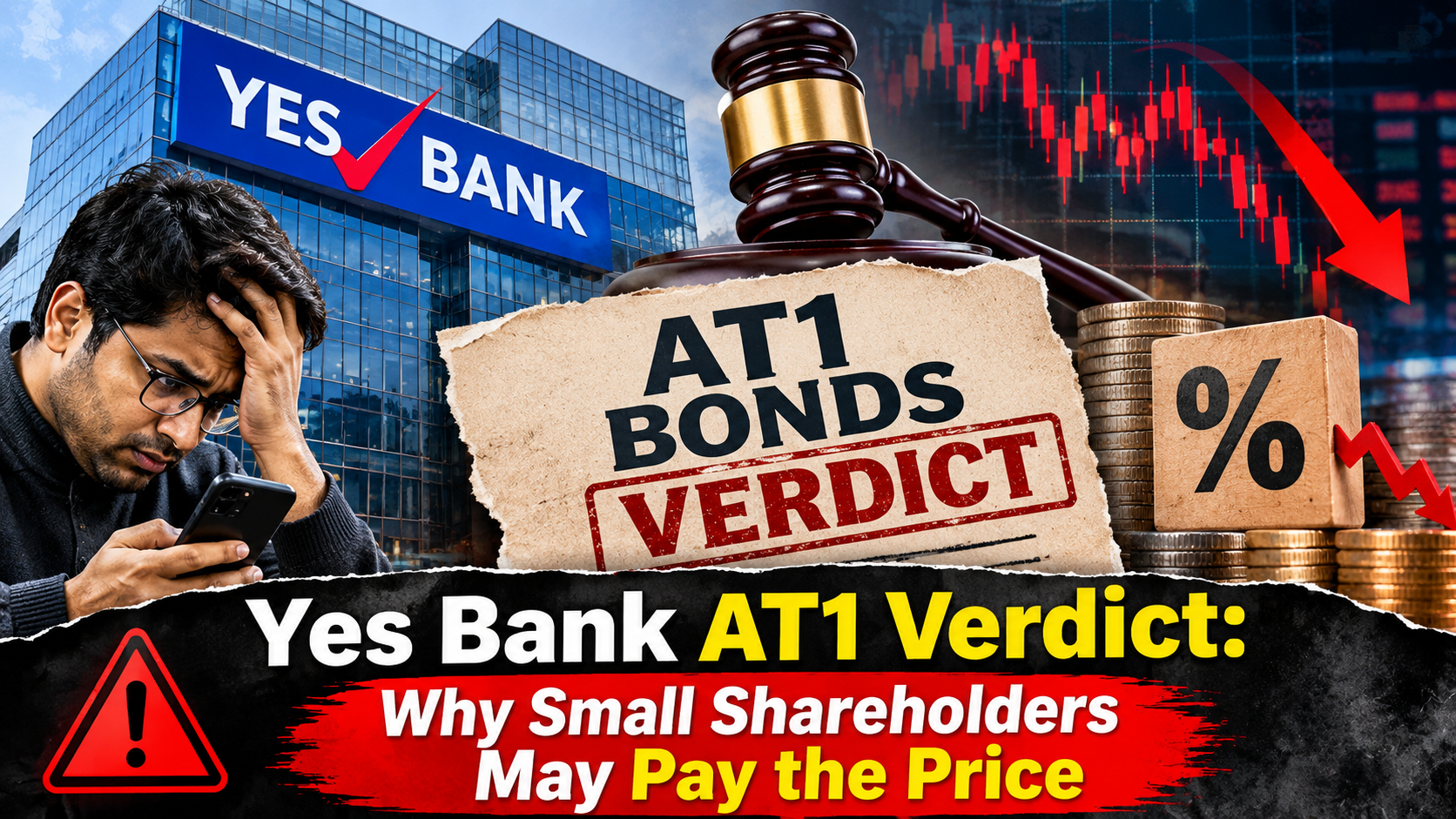
The Yes Bank AT1 bond case is back in the spotlight, and this time the worry is for small investors. After the Supreme Court refused to restore the 2020 write-off of ₹8,415 crore of Yes Bank's AT1 bonds, nearly 60 lakh small shareholders, along with large investors, could end up bearing the cost, analysts told The Hindu.
Yes Bank and the RBI have now asked the Supreme Court to review its own verdict. Here is what happened and what it means for you if you hold Yes Bank shares.
Yes Bank AT1 case: key facts↑
| Detail | Fact |
| Bonds written off | ₹8,415 crore of AT1 bonds, in March 2020 |
| Bombay High Court | Quashed the write-off on January 20, 2023 |
| Supreme Court | Upheld the High Court order on October 15, 2026 |
| Review petitions. | Filed by Yes Bank and the RBI |
| Small shareholders | 56,68,223 holding up to ₹2 lakh of share capital (Business Today) |
What are AT1 bonds?↑
Additional Tier 1 (AT1) bonds are a special kind of bond that banks issue to raise capital. They pay higher interest than normal bonds, but they carry more risk. AT1 bonds are part of a bank's regulatory capital and are designed to absorb losses when a bank runs into serious trouble, as explained by Business Today.
Yes Bank's ₹8,415 crore of AT1 bonds were issued in December 2016 and October 2017, according to Sahi.
What happened in 2020?↑
In March 2020, Yes Bank was rescued under a government-backed reconstruction scheme. On March 14, 2020, the administrator appointed by the RBI told stock exchanges that the bank's AT1 bonds had been written down to zero, according to Moneylife.
Bondholders, represented by Axis Trustee Services, challenged this. The Bombay High Court ruled that the bank was reconstituted on March 13, 2020, when the final scheme took effect, so the administrator had no power to write off the bonds a day later, Moneylife reported.
What the Supreme Court said↑
On October 15, 2026, a bench of Justices Dipankar Datta and Augustine George Masih dismissed the appeals filed by Yes Bank, the RBI, and the Centre, as reported by PSU Connect. The court held that the administrator could not take over the RBI's regulatory powers to write down the bonds, according to Moneylife.
"We see no reason to interfere with the impugned judgment," the bench said, as reported by Moneylife.
Timeline of the case↑
- March 13, 2020: The Yes Bank reconstruction scheme takes effect.
- March 14, 2020: Administrator writes down ₹8,415 crore of AT1 bonds.
- January 20, 2023: Bombay High Court quashes the write-down.
- March 3, 2023: Supreme Court puts the High Court order on hold (LawChakra).
- October 15, 2026: Supreme Court dismisses the appeals.
- November 6, 2026: Axis Trustee e-files a contempt petition, saying Yes Bank has not given a "concrete roadmap" to comply.
- November 13, 2026: Yes Bank discloses that it has filed a review petition.
Why small shareholders could pay the price↑
If the bonds are restored, the ₹8,415 crore goes back on Yes Bank's books as a claim. That reduces the value left for the bank's shareholders.
Brokerages have already worked out the impact. According to Business Today:
- Yes Bank's indicative pro forma figures show a net loss of ₹5,217 crore and a core capital (CET1) ratio of 11.4%.
- Nomura said the reinstatement cuts shareholders' equity for the September quarter by 12%.
- ICICI Securities said the ruling involves no cash outflow, but a lower capital ratio could slow growth and bring forward a capital raise.
When a bank raises fresh capital by issuing new shares, each existing share's slice of the bank becomes smaller. This is called dilution, and it is one reason the share price has fallen.
"If the court does not agree to review the order, it will impact the millions of retail shareholders," analyst Shriram Subramanian told The Hindu.
How the share price reacted↑
Yes Bank shares fell about 15% after the verdict, as reported by Outlook Business. By October 21, the stock had fallen for four straight days, losing 24.38% and hitting a low of ₹16.03, Business Today reported.
What should Yes Bank shareholders do?↑
EEST TV does not give investment advice, but here are a few simple points to keep in mind:
- Do not panic-sell on headlines. The review petitions are still pending, and the final outcome is not yet known.
- Watch for a capital raise. Any announcement of new shares will matter for existing holders.
- Follow official updates. Check Yes Bank's stock exchange filings on the NSE and BSE websites.
- Talk to a registered adviser before making a big decision.
Read our report on how the RBI brought home 60 tonnes of gold, and on retail inflation in October.
FAQ
Q1. What is the Yes Bank AT1 bond case? In March 2020, ₹8,415 crore of Yes Bank's AT1 bonds were written off during its rescue. Courts have now ruled that the write-off was not valid.
Q2. What did the Supreme Court decide? On October 15, 2026, it upheld the Bombay High Court order that quashed the write-off.
Q3. Has Yes Bank challenged the verdict? Yes. Yes Bank and the RBI have filed review petitions in the Supreme Court.
Q4. How many small shareholders does Yes Bank have? 56,68,223 small shareholders hold up to ₹2 lakh of share capital, according to Business Today.
Q5. Will Yes Bank have to pay cash to bondholders? ICICI Securities said the ruling involves no cash outflow, but it hits the bank's capital.



0 comments
No comments yet. Comments are read by our team before they appear.