

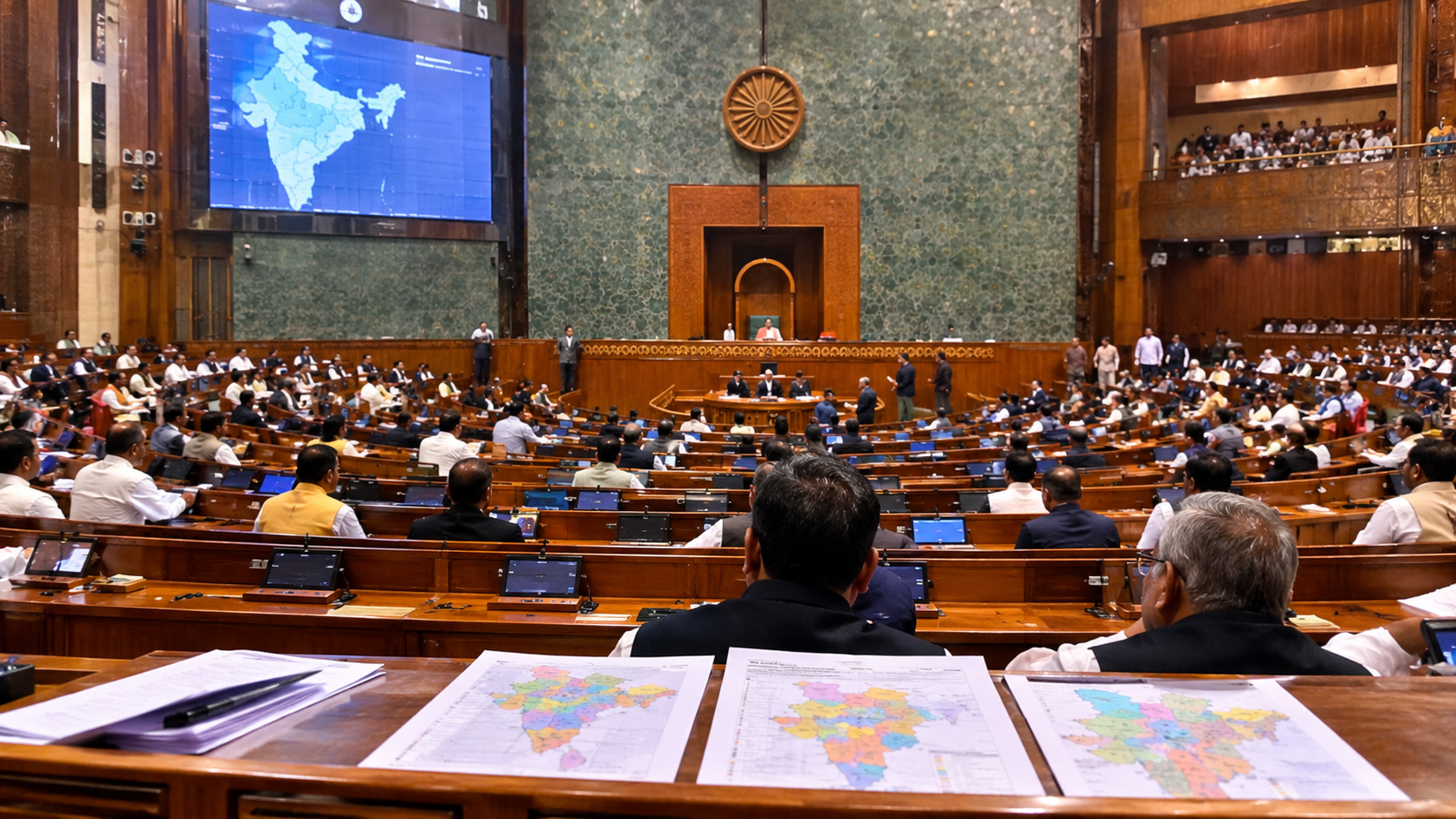
The Delimitation Bill 2026 is back. The Centre is set to introduce the Delimitation (Second) Bill, 2026, in a Special Session of Parliament beginning Monday, November 30, after the Union Cabinet approved a uniform 50% increase in Lok Sabha seats for every state, as reported by ANI.
The bill could change the size of the Lok Sabha for the first time since the 1970s. Here is what the new proposal says, why it failed in April, and what it means for your state, explained in simple words.
Delimitation Bill 2026: key facts↑
| Question | Answer |
| Bills | Delimitation (Second) Bill, 2026, and Constitution (132nd Amendment) Bill, 2026 |
| Main proposal | 50% more Lok Sabha seats for every state and UT |
| Lok Sabha size now | 543 seats |
| Lok Sabha size if passed | About 815 seats |
| Freeze | Seat numbers frozen for 25 years |
| Linked to | 33% reservation for women in legislatures |
| Special Session | Lok Sabha from Nov 30; Rajya Sabha from Dec 2; ends Dec 3 |
What is delimitation?↑
Delimitation means fixing the number of seats in Parliament and state assemblies and redrawing the boundaries of each constituency. It is done by an independent Delimitation Commission.
The current allocation of Lok Sabha seats among states is still based on the 1971 Census, as explained by PRS Legislative Research. This freeze was put in place so that states that controlled their population would not lose seats.
What does the new bill propose?↑
According to Open magazine, which reviewed the bill:
- 50% more seats: Lok Sabha seats for each state and Union Territory rise by 50%.
- Assemblies too: Seats in state assemblies rise by the same proportion.
- Delimitation Commission: A commission will be set up after the law comes into force to carry out the exercise.
- Women's reservation: The Cabinet also approved the Constitution (132nd Amendment) Bill to enable delimitation and implement the Nari Shakti Vandan Adhiniyam, which gives women 33% of seats.
ANI reported that the bill proposes a freeze on seat numbers for 25 years.
How many seats will the Lok Sabha have?↑
By our calculation, 543 × 1.5 = 814.5. In April, Union Law Minister Arjun Ram Meghwal said the total would go up from 543 to 815, of which 272 would be reserved for women, according to Business Today. Home Minister Amit Shah later put the figure at 816, according to Oneindia. The final number will depend on the bill's text.
What changes for your state?↑
Because every state gets the same 50% rise, each state's share of the House stays almost the same. Here are some examples based on figures cited during the April debate:
| State | Seats now | Seats after 50% rise (approx.) |
| Uttar Pradesh | 80 | 120 |
| Tamil Nadu | 39 | 59 |
| Karnataka | 28 | 42 |
| Kerala | 20 | 30 |
The UP and Tamil Nadu figures were cited by Congress leader Jairam Ramesh, as reported by Scroll. The Karnataka and Kerala figures come from Home Ministry data reported by Oneindia.
Why this matters: In April, projections based on the 2011 Census showed that a population-based reallocation would have cut Tamil Nadu's share from 7.18% to 5.88%, according to Outlook. A uniform 50% rise avoids that cut, which is why some southern parties are now more open to the idea.
Why did the bill fail in April?↑
In April, the government brought the Constitution (131st Amendment) Bill along with two other bills. A constitutional amendment needs a two-thirds majority of members present and voting.
On April 17, 298 MPs voted in favor. With 528 MPs present, the bill needed 352 votes, so it failed, according to Scroll. The government then withdrew the other two bills.
Can it pass this time?↑
The numbers are still tight. The Lok Sabha's effective strength is 536, as reported open, since three seats are vacant, two MPs are in jail, and one is suspended. By our calculation, if all 536 vote, the government needs at least 358 votes (two-thirds of 536 is 357.3).
The NDA has over 300 members, including 20 TMC MPs who broke away from their party, so it needs more support, Open reported.
Where parties stand:
- NCP (SP), 8 MPs: Jitendra Awhad said the party will support the delimitation process.
- Andhra Pradesh CM Chandrababu Naidu: Backs the 50% increase, saying it gives relief to southern states.
- YSRCP: Reportedly inclined to support southern representation if protected.
- DMK: MP P Wilson said Tamil Nadu's 7.18% share and a 25-year freeze are non-negotiable.
- Congress and several INDIA bloc allies: Say they will oppose.
These positions were reported by Open.
What the government and opposition say↑
Government's case: In April, Home Minister Amit Shah told the Lok Sabha that after a 50% rise, the share of MPs from southern states would go from 23.76% to 23.97%, so their strength would increase, not reduce, as reported by Newslaundry. The government says the change is needed to implement women's reservation.
Opposition's concerns: Rahul Gandhi has alleged that the government wants to "gerrymander" Lok Sabha seats before the 2029 elections, Scroll reported. The Opposition has also objected that the session is being held within the Monsoon Session, allowing a two-day notice instead of the 14 days needed for a fresh session.
What happens next?↑
- Monday, Nov 30: Lok Sabha meets; the bills are expected to be introduced.
- Wednesday, Dec 2: Rajya Sabha meets.
- Thursday, Dec 3: Special session ends.
Both houses must pass the constitutional amendment with a two-thirds majority. EEST TV will update this story as the debate unfolds.
Read our report on Constitution Day 2026 to know more about how India's Constitution works.
FAQ
Q1. What is the Delimitation Bill 2026? It proposes a uniform 50% increase in Lok Sabha and assembly seats for every state and sets up a Delimitation Commission.
Q2. How many Lok Sabha seats will there be? About 815, up from 543, according to figures given by the government in April.
Q3. When will the bill be introduced? In the Special Session of Parliament starting November 30, 2026.
Q4. Why did the delimitation bill fail in April? It got 298 votes, short of the 352 needed for a two-thirds majority of the 528 MPs present.
Q5. Will southern states lose seats? Under a uniform 50% rise, every state gains seats, and its share stays almost the same.



0 comments
No comments yet. Comments are read by our team before they appear.