

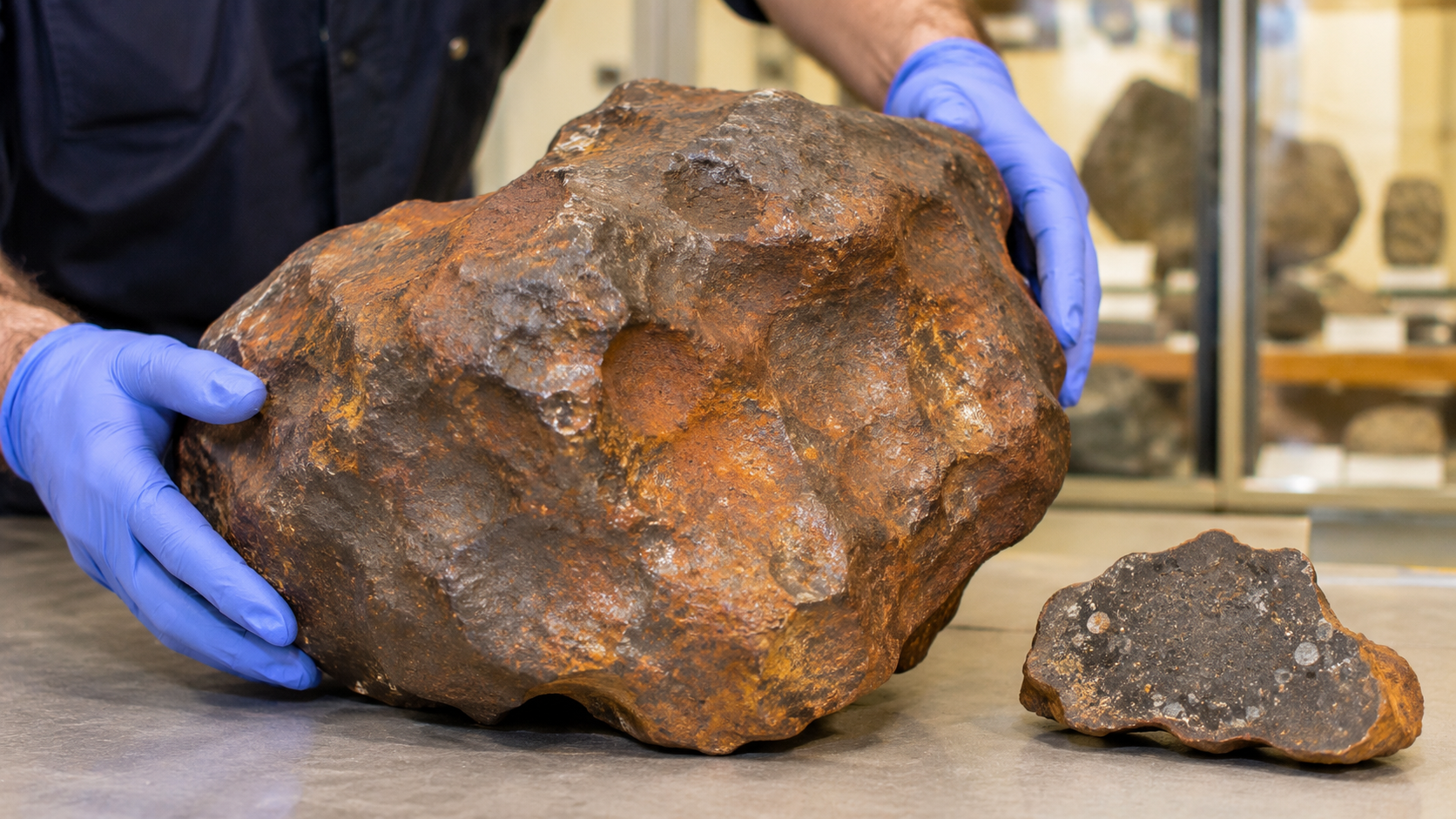
The Maryborough meteorite is trending again, and the story sounds almost too good to be true. An Australian man kept a heavy reddish rock for years, hoping there was gold inside. When he finally took it to a museum, experts told him it was something far rarer: a 4.6-billion-year-old meteorite, older than Earth's oldest rocks, according to ScienceAlert.
The find was first reported in 2019, but it has gone viral once more this week. Here is the full story, what makes this space rock special, and how you can tell if a rock you find could be a meteorite.
Maryborough meteorite: key facts↑
| Question | Answer |
| Found by | David Hole, with a metal detector |
| Year found | 2015 |
| Where | Maryborough Regional Park, central Victoria, Australia |
| Weight | 17 kg (37.5 pounds) |
| Age | About 4.6 billion years |
| Type | H5 ordinary chondrite, high in iron |
| Likely origin | The asteroid belt between Mars and Jupiter |
| Time on Earth | Less than 1,000 years, by carbon dating |
| Identified by | Melbourne Museum geologists Dermot Henry and Bill Birch |
How the story began↑
In 2015, David Hole was searching for gold with a metal detector in Maryborough Regional Park, near the town of Maryborough in Victoria. Maryborough lies in Victoria's goldfields, an area famous for the gold rush of the 1800s.
He found a very heavy, reddish rock lying in yellow clay. Sure that it held a gold nugget, he took it home, ScienceAlert reported.
He could not break it open↑
Hole tried everything to open the rock. He used a rock saw, an angle grinder and a drill, and even soaked it in acid. Even a sledgehammer could not crack it, according to ScienceAlert.
That toughness was the first clue. Many meteorites are dense and contain a lot of iron, which makes them very hard to break.
The museum's surprise↑
Years later, still curious, Hole took the rock to the Melbourne Museum. There, geologists Dermot Henry and Bill Birch identified it as a meteorite.
"It had this sculpted, dimpled look to it," Henry said, describing what made them suspect it came from space, as quoted by ScienceAlert. Such dimples form when the outer surface of a meteorite melts as it races through Earth's atmosphere.
Why scientists are excited↑
The rock is far more valuable to science than a gold nugget. Here is why:
- It is very old. At about 4.6 billion years, it dates back to the birth of our solar system. It can tell scientists how planets formed.
- It is rare. "This is only the 17th meteorite found in Victoria," Henry said, as quoted by ScienceAlert.
- It is big. It is the second-largest chondrite mass found in Victoria, after a 55-kg specimen identified in 2003, ScienceAlert reported.
The scientists published their findings in the Proceedings of the Royal Society of Victoria.
What is a chondrite?↑
A chondrite is the most common type of stony meteorite. It contains tiny round grains called chondrules, which formed in the early solar system. The Maryborough meteorite is an "H5 ordinary chondrite", meaning it is a stony meteorite with a high iron content, ScienceAlert noted.
Meteor, meteorite, asteroid: what is the difference?↑
Many people mix up these words. Here is a simple guide:
| Word | Meaning |
| Asteroid | A rocky object orbiting the Sun, mostly in the belt between Mars and Jupiter |
| Meteoroid | A small piece of rock or metal travelling through space |
| Meteor | The streak of light ("shooting star") when a meteoroid burns up in the air |
| Meteorite | A piece that survives the fall and lands on the ground |
So the Maryborough rock is a meteorite, because it survived its fall and landed on Earth.
How to tell if a rock could be a meteorite↑
This is the question most readers will have. Real meteorites are rare, and most "space rocks" people find turn out to be ordinary rocks. But these simple signs can help:
- Heavy for its size: Most meteorites contain metal, so they feel heavier than normal rocks of the same size.
- Attracts a magnet: Many meteorites contain iron, so a magnet will stick to them.
- Thin dark crust: A fresh meteorite often has a thin, dark outer layer, called a fusion crust, formed by melting during its fall.
- Dimples: Some have thumbprint-like dents, like the Maryborough meteorite.
- No bubbles: Rocks with many small holes are usually volcanic, not meteorites.
If you think you have found one: Do not try to cut, break or treat it with acid, as Hole did. Keep it safe and contact a university geology department or a science museum. In India, the Geological Survey of India studies meteorites and can be approached for advice.
Do meteorites fall in India?↑
Yes. Meteorites do fall in India from time to time, and many are kept in collections for study. If you love watching the sky, the Geminid meteor shower peaks on December 13 to 14 this year, a good chance to see shooting stars from India.
For more science and nature stories, read our report on Cyclone Akvan's landfall in Andhra Pradesh and on Delhi's coldest morning of the season.
FAQ
Q1. What is the Maryborough meteorite? A 17-kg meteorite found in 2015 near Maryborough, Victoria, Australia, by a man who thought it contained gold.
Q2. How old is the Maryborough meteorite? About 4.6 billion years old.
Q3. Who found it? David Hole, while searching for gold with a metal detector.
Q4. Is a meteorite more valuable than gold? For science, yes. It holds clues about how the solar system formed, and only 17 meteorites have been found in Victoria.
Q5. How can I tell if a rock is a meteorite? Check if it is heavy for its size, attracts a magnet, and has a thin dark crust. Then ask a geology expert.


0 comments
No comments yet. Comments are read by our team before they appear.